
That vexed question has troubled researchers for a long time now. Short of a direct answer to that direct question, we are able to think about what else was going on at the time and put two and two together, to hopefully give us the correct answer.
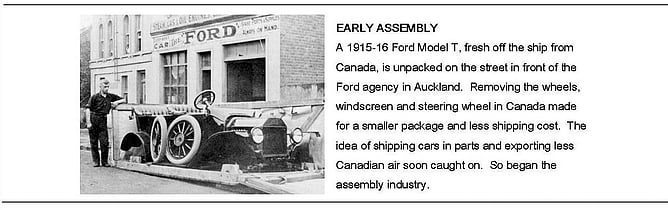
The Ford Motor Company, having discovered the cost benefits of shipping parts rather than completed cars, led the motor industry in remote assembly. The earliest example of Ford assembly in New Zealand was seen in how Ford of Canada, who supplied cars to the Commonwealth for tariff reasons, shipped their cars. The earliest Model Ts were crated and dispatched to their markets in boxes a little smaller than the size of the completed car (see image below).
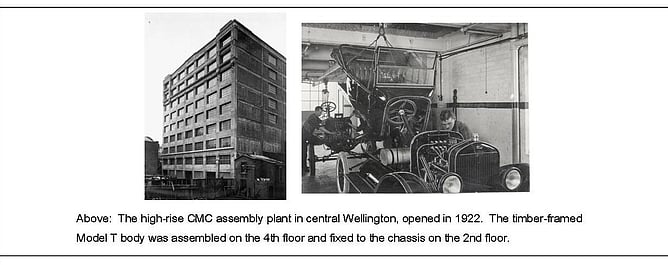
The first car assembly plant in New Zealand opened in 1922. Modelled on Ford assembly plants in America, Model Ts now arrived in parts. Assembly was conducted over seven floors at the purpose-built nine-storey plant in central Wellington, which had been built for the Ford distributor in this country, The Colonial Motor Company. The parts were distributed throughout the seven floors and the assembly process was progressive down the seven floors, with a finished car emerging from the ground floor. According to Roger Gardner’s excellent book on the history of The Colonial Motor Company , body assembly happened on the fourth floor, and bodies were attached to their chassis on the second floor.
However, the way cars were built changed rapidly and significantly in the mid-1920s, with bodies now of all-steel construction. For assembly, the parts were held for precision welding in heavy, unique-to-a-model and expensive jigs. With the arrival of the "New Beauty" Model T in late 1925, gone was the wooden framing - now the Model T was of all-steel construction, and the way they were assembled suddenly changed.
It is this researcher’s view that New Zealand assembly of Ford bodies stalled at that point. It is possible that limited assembly was conducted at the plant – possibly some upholstery manufacturing, for instance – but the nature of the industry had drastically altered. In his writings, respected vintage car authority, the late-Douglas Wood, provided us with some first-hand evidence when he described his first job after leaving school in Auckland – he was employed by the Auckland Ford agent, and tasked to unpack new Model A Fords from their shipping crates from Canada on the wharves. He would attach the wheels and windscreens and drive them to the dealership. Ford was now shipping these later models (Model As were current between 1927 and 1931) in the same way that the earliest Model Ts were, as illustrated above.
The design of Ford’s assembly overseas changed too, with the work now carried out on one level, over a massive area and with parts distributed by conveyor belts. General Motors, who had now caught up to Ford's practices, built New Zealand's second assembly plant in 1926, in Petone - which was built on one level, covering 100,000 square feet (9,300 square metres).
With this manufacturing change, The Colonial Motor Company looked for additional land upon which they could expand with such an assembly plant on one level. They settled on a large parcel on Taranaki Street, behind the now outdated assembly plant. (This land would subsequently become Avery Motors.)
But there was much else happening at the time which would influence investment decisions. Perhaps the greatest was the onset of the Great Depression in 1929. Business shut down all over the world until the mid-1930s, and unemployment reached record levels.
Another factor was Ford's 1928 Plan. This had set out the path the global business would take. The company would still rely on just one global model to serve all markets – this was the just-released Model A. In Britain, the massive new factory at Dagenham was under construction, and it would build the Model A for the British and European markets. Ford of Canada would built the Model A for the Canadian home market and for the British Commonwealth (excluding Britain). Ford in Detroit would supply Model A to the rest of the world.
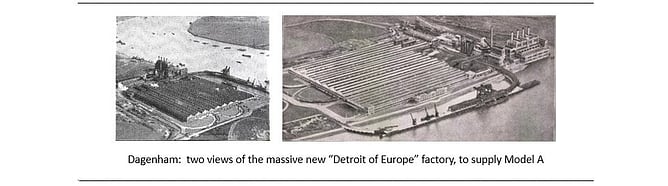
But all was not well in Britain, where the horsepower tax deemed the Model A uncompetitive, especially against the small British models such as the Austin Seven. Not only was the Model A unaffordable in Dagenham's home market, but the rise of nationalism in Europe made the Model A undesirable there. So serious was this for Ford of Britain that the viability of the new Dagenham plant threatened the global company.
Going back for a moment to the early 1920s, following major product quality problems in South Africa and in Australia, Ford of Canada had decided to dispense with their agents in those two markets and set up their own operations (respectively Port Elizabeth in 1924 and Geelong in 1925). The assembly plants they built were, of course, of the new one-level design. Whilst Ford of Canada was satisfied with their arrangements in New Zealand, Ford directors will have questioned for how long they should continue to leave Ford product in the hands of outside agents. The Colonial Motor Company will have thought about this.
Finally, there was the matter of preferential tariffs. During the 1920s the British-based Society of Motor Manufacturers and Traders (SMMT) had been actively encouraging the New Zealand government to buy more British-made cars to balance our farming exports to Britain. Whilst the tough Fords from America had always been better suited to the colonial road conditions in New Zealand, as sealed roads were built the British cars became more suitable. Nevertheless, in tariff discussions, The Colonial Motor Company continued to refer to Canadian vehicles as British-made, or Made in the Empire, and the tariffs as British Empire tariffs.
With all this going on, page 73 of The Colonial Motor Company history states that, before proceeding with the construction of a new assembly factory, Colonial would await the outcome of the 1934 tariff discussions.
Matters then moved very fast. The tariffs favoured Britain, with a surcharge on Canadian-sourced cars. All other sources were heavily taxed. The government, in an effort to stimulate employment, actively favoured motor vehicle assembly with locally-made content (such as carpets, tyres, glass, batteries, etc). And, with that, Ford of Canada decided to set up in New Zealand in their own right, and announced it was they who would establish the new assembly plant.
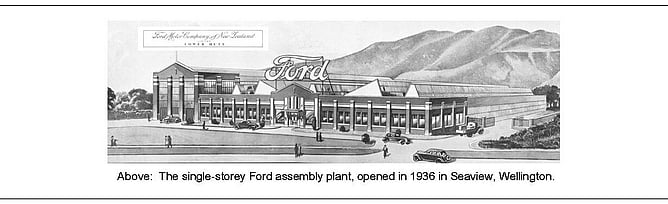
Seaview, in Lower Hutt, was chosen as the site as the flat land was available and the government, intent on attracting industry, was building the necessary infrastructure such as roads, rail, water and electricity. The government also accelerated a state-housing scheme to accommodate the workers that would be required, and created a public transport programme to get them between home and work. A whole new era of industrial prosperity in New Zealand was about to begin....
By reading the foregoing, you have probably reached the same conclusion, that the Fords sold in New Zealand from the end to the Model T era until the arrival of the Ford Motor Company in 1936, were not actually built here.
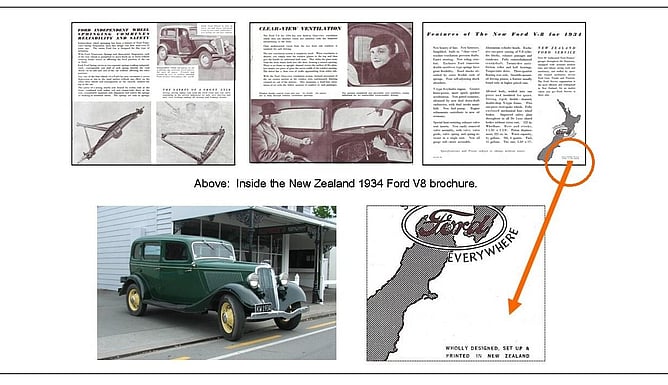
To support this, it was exciting to find an original New Zealand Ford V8 product brochure from 1934 – see the images below. The brochure is said to be “Wholly designed, set up and printed in New Zealand” – yet it does not mention that that products being promoted were in any way made in New Zealand, at a time when such a statement would have spoken volumes.
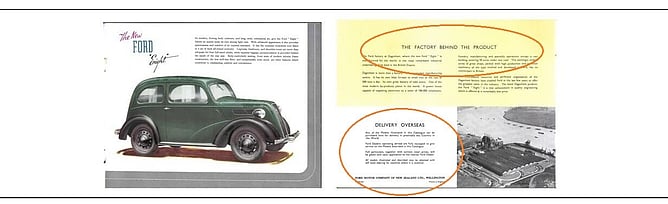
In the same old car brochure collection there was an English Ford brochure from 1937, also printed by Ford New Zealand, for the all-new Ford Eight. This is relevant to this story because, when the Ford plant was built at Seaview and under the 1928 Plan, the expectation was that it would only build Canadian-sourced models. Dagenham-built Fords were, of course, for the home and European markets – and that is why this brochure, printed in New Zealand, says “…the models illustrated in this catalogue can be purchased for delivery to practically any country”.
The brochure – clearly designed in Britain – also says “All models illustrated and described may be obtained with left-hand steering for countries where it is essential.” When Dagenham was designed, no thought had yet been given to their models being made available for remote assembly (ie CKD packs).
But that soon changed! The Seaview Ford plant was built in 1936. Its floor area was 122,000 square feet (11,300 square metres). The official opening was in April, 1937. Just eight months later, the plant was being extended to 183,000 square feet (17,000 square metres) – see page 56 of the Ford in New Zealand book. This was not a planning mistake by Ford of Canada, who had much experience in planning and building assembly plants. This was Ford of Canada helping to rescue the struggling Dagenham plant, as discussed above. Suddenly, Ford New Zealand was expected to also build British-sourced Fords from Mother England – and Dagenham had very quickly learned how to pack for remote assembly. Seaview now had the space to build them!
All of this is circumstantial evidence, but it certainly does point to little or now New Zealand assembly of Fords in the ten year period 1926 to 1936.